
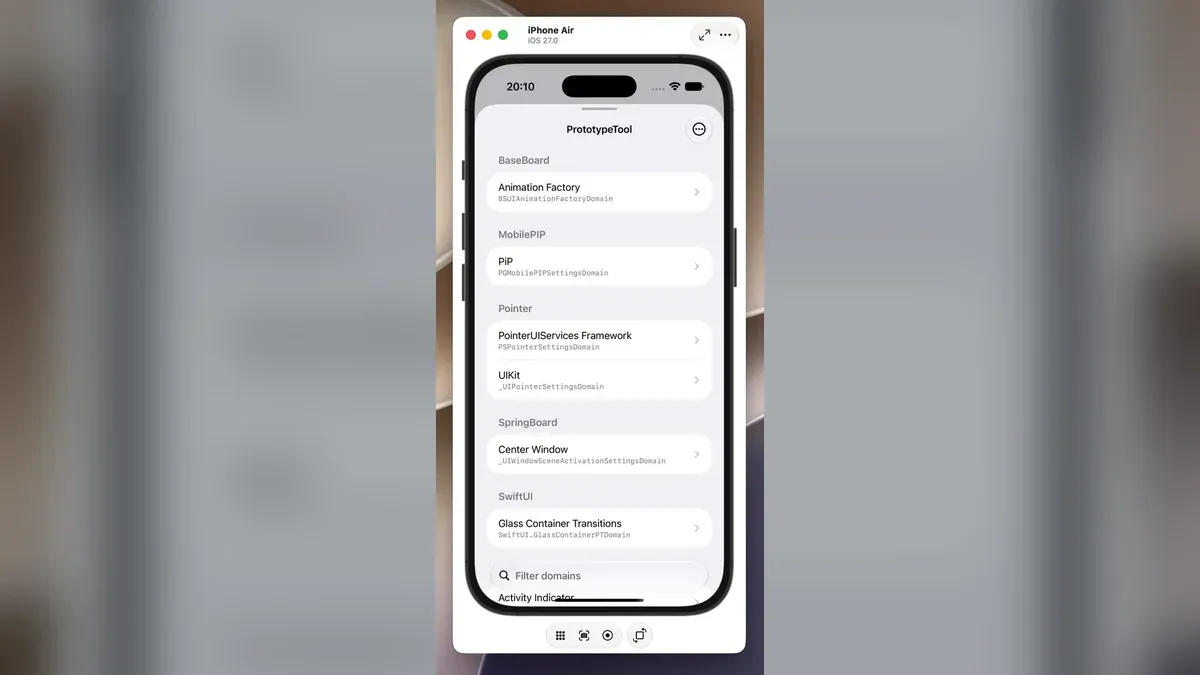
A short video posted by Cyan shows an Apple framework named PrototypeTools exposing live controls for system interactions and animations. Values can be adjusted while the interface is running, apparently from another device as well. It is a glimpse of an internal workflow, not a public SDK announcement, but the interesting part is not the hidden framework. It is the way the interface is treated as a set of tunable behaviours rather than a pile of constants waiting for the next build.
That distinction matters whenever motion is part of how a product communicates state.
A slider changes the design conversation
Animation code often begins with numbers chosen in source: duration, damping, velocity, scale and opacity. If each change requires editing, compiling and navigating back to the same screen, comparison becomes slow. People remember the previous version imperfectly, and feedback drifts toward vague language such as “make it softer”.
A live control panel turns that discussion into an experiment. A designer and an engineer can change a spring, repeat the gesture and compare the result immediately. The parameter is visible, the consequence is observable and the chosen value can be recorded.
The same approach works beyond animation. Layout thresholds, blur intensity, gesture resistance and transition timing can all be represented as named parameters with sensible ranges. The tool does not replace judgement; it removes friction from exercising it.
The useful architecture is fairly small
A production team does not need Apple’s private framework to adopt the method. It needs a narrow layer between implementation defaults and a development-only control surface:
- typed parameters with documented units and allowed ranges;
- a way to update them without rebuilding the application;
- presets so two variants can be reproduced instead of remembered;
- capture or export of the final values back into source control.
Remote control is useful when the target device is in someone’s hand, connected to a television or running a full-screen prototype. It also adds a trust boundary. A tuning endpoint should be disabled in release builds, restricted to a local or authenticated session and unable to invoke arbitrary application behaviour. Shipping an undocumented debug socket would turn a design convenience into an attack surface.
Prototype behaviour still needs real constraints
Live tuning can make one transition feel excellent on one device while hiding other problems. A heavy blur may miss its frame budget on older hardware. A spring that feels natural for a short card expansion may be exhausting when repeated through a list. Larger text, reduced-motion preferences and right-to-left layouts can change the geometry entirely.
For that reason, the output of a tuning session should not be just “0.72 feels right”. It should include the states tested and the limits that keep the value safe. Reduced-motion behaviour deserves its own deliberate path, not an animation with the duration set close to zero.
Apple’s public Human Interface Guidelines make a similar practical point: motion should help people understand what changed and should remain responsive. PrototypeTools appears to make that principle cheaper to test, but it cannot decide whether the motion has a purpose.
Do not build on the private framework
The post is evidence that the tool exists in an Apple environment; it is not documentation, a stability promise or permission to distribute it. Depending on private frameworks can lead to rejected software, broken releases and security assumptions that cannot be audited against a supported contract.
The transferable idea is safer and more useful: keep interaction parameters explicit, make them adjustable during development, test them on real hardware, then freeze reviewed values into the application. The hidden tool is interesting. The workflow it reveals is the part worth keeping.