
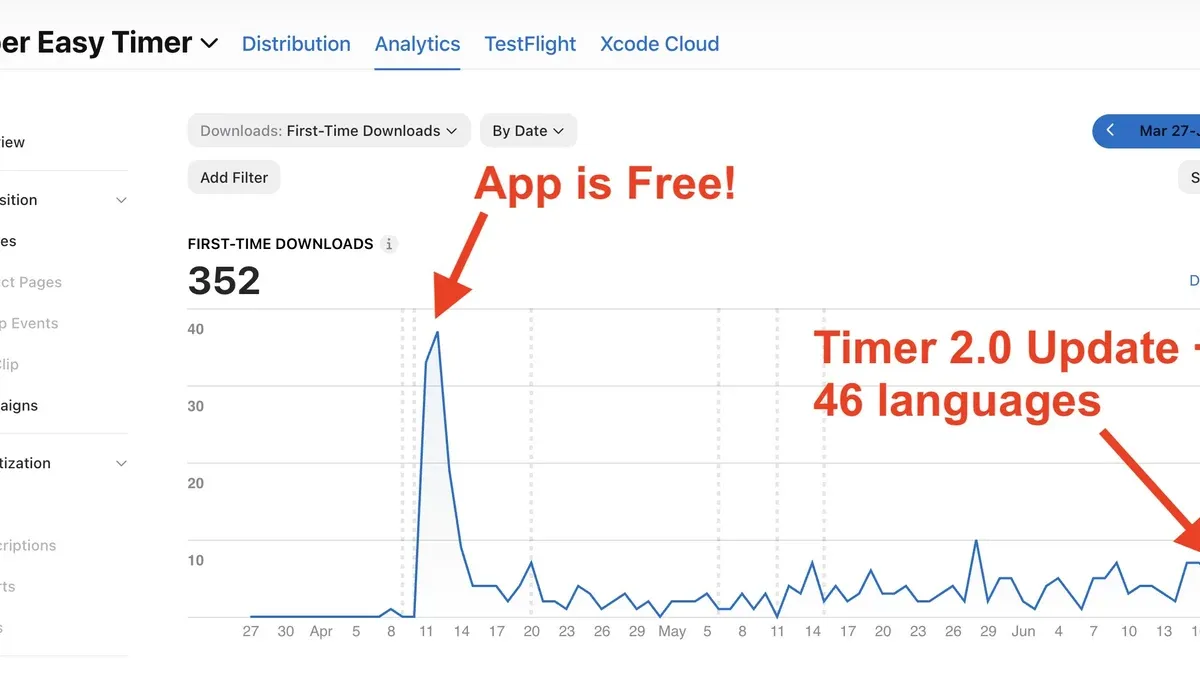
Paul Solt posted that he localized a Mac App Store page into 46 languages in four minutes and 33 seconds with ASC Buddy. He also reported 51 keywords ranking in the top ten, 141 downloads during the month and an 88% increase over the previous 30 days. The post was sponsored, which is relevant context, but the result still illustrates a genuine change in App Store operations: automation can make broad metadata coverage cheap enough to test.
What it cannot do is turn one dashboard into proof of causation.
Localization changes the surface people can find
Apple’s App Store Connect documentation explains how developers can localize names, subtitles, descriptions, keywords and other App Store information for supported languages and regions. That metadata affects how a listing is understood and, where applicable, searched. Leaving every locale in one language gives potential users a poor first encounter even when the application itself is localized.
The operational work is repetitive: create locale records, fit text within field limits, upload the values and keep them synchronized when positioning changes. An API-backed tool can compress that work dramatically. Four minutes becomes plausible because the slow part has moved from clicking forms to preparing and validating structured input.
The distinction between translation and localization remains. A literal translation can miss the terms people actually search, use a tone that feels imported or promise a feature differently from the application. Store copy also needs to agree with screenshots, onboarding and support material. Scaling the upload does not eliminate editorial review; it makes the review queue larger.
Treat every locale as a controlled change
A useful workflow separates generation, validation and publication:
- start from a versioned source record for each metadata field;
- preserve placeholders, product names and character limits;
- flag regulated or high-risk claims for human review;
- compare the proposed locale with the current App Store Connect value;
- publish through an account with the narrowest required role;
- keep an export that can restore the previous metadata.
Credentials are the main security concern. An App Store Connect API key can affect public product information and possibly more, depending on its role. It should live in a secret manager, never in a spreadsheet or generated file, and the automation should log field changes without logging the private key. A dry-run diff is worth more than a clever prompt when 46 storefronts are involved.
The numbers need a baseline
An 88% download increase sounds decisive until the denominator, seasonality and other changes are considered. The app may have shipped an update, gained a mention, changed price or benefited from a small starting volume. Keyword rank can also vary by country, device and measurement tool.
The honest way to evaluate the localization is to retain the dates, locales and metadata changed, then compare impressions, product-page views, conversion and downloads by storefront. Search rank is one diagnostic, not the outcome. A longer observation window helps distinguish a durable improvement from a short spike.
There is also no need to launch every language at once. A small set of markets can reveal broken terminology, truncation and support demand before the process expands. Automation makes staged rollout easier because the same structured source can be reused.
Speed changes what is affordable to learn
The important result in Solt’s post is not that localization can be “finished” in under five minutes. It is that the mechanical cost of creating and updating locale metadata can fall far enough to support more experiments.
The lasting system has three parts: automated transport, local editorial judgement and measurement tied to each storefront. Remove any one of them and the result is either slow, culturally weak or impossible to evaluate. Fast publishing is useful. A traceable localization loop is the actual advantage.